
How the 4S Productivity Stack and AI Compass Can Build Trust and Deliver Real-World Impact
Introduction: Retail at a Turning Point
Retail is evolving at unprecedented speed.
Generative AI promises to reimagine everything—from creating product descriptions and personalising recommendations to optimising supply chains and reducing waste.
But retail has always been more than transactions. Trust, brand reputation, and customer relationships are the heart of success. Overusing AI risks eroding that foundation.
Staying still isn’t an option. Legacy systems and outdated processes already frustrate customers and constrain growth. The real question isn’t whether to adopt GenAI—but how to do it responsibly, transparently, and in a way that feels genuinely human.
Two practical frameworks can help:
✅ The 4S Productivity Stack—a set of GenAI capabilities that support, not replace, your teams.
✅ The AI Compass Readiness Framework—a simple guide to assess if your culture, governance, skills, and infrastructure are ready for safe adoption.
Used together, they provide a roadmap to unlock innovation while protecting what makes your brand trusted.
What is the 4S Productivity Stack?
The 4S Stack organises GenAI into four capabilities that are especially relevant to retail:
Simulation
Model “what-if” scenarios, like inventory planning or demand forecasting, before you commit resources.
Summarisation
Condense large volumes of reviews, feedback, or policies into clear insights your teams can act on.
Synthesisation
Connect data across systems—from e-commerce and POS to marketing—so decisions are better informed.
Suggestion
Recommend products, promotions, or actions based on patterns in customer behaviour and preferences.
These capabilities are practical, low-barrier ways to begin working with AI that keep humans in control.
Linking 4S to Retail Challenges
Each area of the 4S Stack can address common retail hurdles:
Simulation reduces risk by testing ideas in a safe environment.
Summarisation cuts through information overload so teams can focus.
Synthesisation connects silos between channels, systems, and data.
Suggestion helps personalise the experience without requiring manual intervention for every customer.
Together, they help you start small, demonstrate impact, and build confidence.
Where GenAI is Already Creating Value
Here are examples of where Generative AI is making measurable impact in retail—and how they align to the 4S Stack:
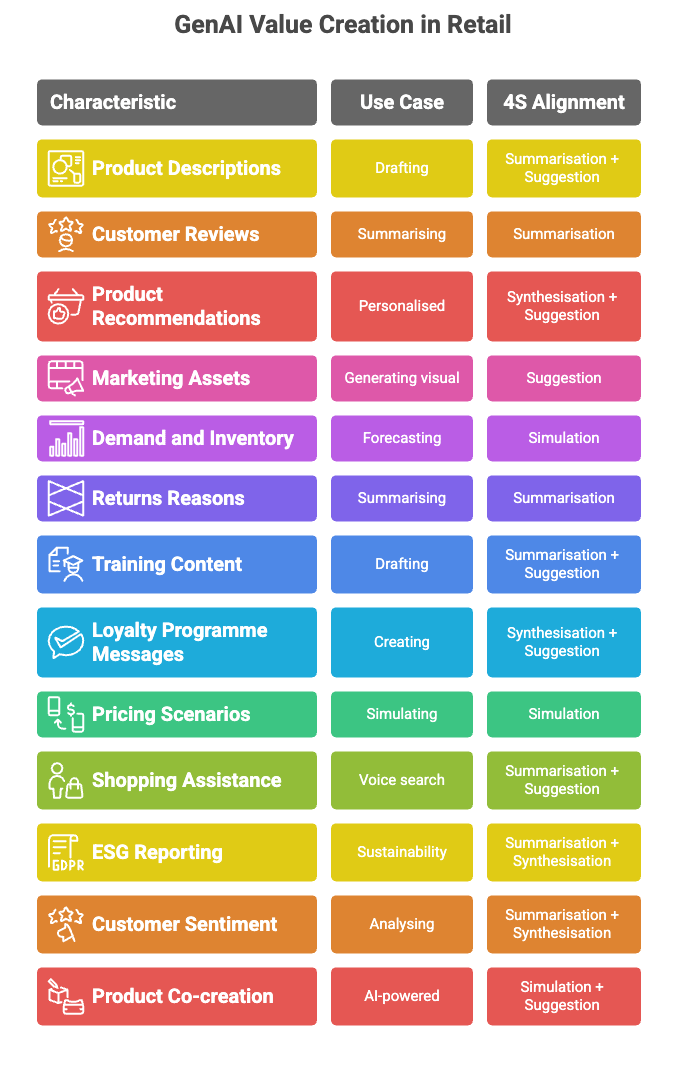
How Generative AI empowers retail: 13 real-world use cases mapped to the 4S Productivity Stack to support a human-first approach.
Most of these applications:
Start with text or image generation rather than full automation.
Include human review as standard practice.
Integrate into existing workflows without massive disruption.
Testing Readiness with the AI Compass
Before you launch pilots, assess your readiness across four areas:
Culture
Do teams understand that AI is a co-pilot, not a replacement?
Is there shared clarity on how GenAI supports customer experience?
Governance
Are policies and accountabilities clear?
Do you know who owns the risks of AI outputs?
Talent
Are your teams trained to oversee and improve AI work?
Is AI literacy part of professional development?
Infrastructure
Is your data secure, structured, and accessible?
Do you have environments to safely test new tools?
How Use Cases Map to Readiness Levels
Quick Wins (Low Readiness Barriers):
Drafting product descriptions
Summarising returns reasons
Translating product or policy documents
Drafting training content
Strategic Pilots (Moderate Readiness Gaps):
Personalised recommendations
Summarising customer sentiment
Forecasting demand
Creating marketing visuals
Complex Initiatives (High Readiness Gaps):
Dynamic pricing simulations
AI-powered co-creation tools
Multichannel voice and chat assistants
ESG reporting automation
Starting small helps build trust and capability before scaling into more complex domains.
A Roadmap for Responsible Adoption
Phase 1: Quick Wins (Months 1–6)
Focus on contained, low-risk use cases.
Show early results and build confidence.
Phase 2: Strategic Pilots (Months 6–18)
Expand into customer-facing and higher-value applications.
Formalise governance and skills development.
Phase 3: Complex Initiatives (Months 18–36)
Integrate GenAI into high-impact areas.
Ensure robust oversight and clear accountability.
Conclusion: A Human-First Future
Generative AI has the potential to make retail more efficient, responsive, and innovative. But sustainable adoption requires clear principles, thoughtful governance, and a commitment to transparency.
By combining the 4S Productivity Stack with the AI Compass Readiness Framework, you can:
✅ Start small but build for scale
✅ Grow trust alongside capability
✅ Make AI adoption as human-centred as it is ambitious
The time to act is now. In retail, keeping the human connection isn’t optional—it’s your strongest advantage.