
How the 4S Productivity Stack and AI Compass Can Build Trust and Deliver Real-World Impact
Introduction: Finance at a Turning Point
Financial services are at a decisive moment.
Generative AI holds enormous promise—streamlining compliance, improving fraud detection, enhancing customer experiences, and unlocking operational efficiency.
But the stakes in finance are higher than most sectors. Trust, fairness, and systemic stability sit at the core of every decision. There’s little room for missteps.
Staying still isn’t an option. Legacy processes and outdated systems already undermine competitiveness and customer confidence. The real question isn’t whether to adopt GenAI—but how to do it in a way that’s responsible, transparent, and genuinely human-centred.
Two frameworks can help organisations find that balance:
The 4S Productivity Stack—a set of GenAI capabilities designed to support, not replace, human expertise.
The AI Compass Readiness Framework—a simple tool to assess whether your culture, governance, skills, and infrastructure are prepared for safe adoption.
Used together, they provide a practical path to accelerate innovation without compromising values.
What is the 4S Productivity Stack?
The 4S Stack organises GenAI into four clear areas of capability:
Simulation
Model “what-if” scenarios.
Test risk exposures and market changes before taking action.
Summarisation
Condense complex regulations, reports, and research.
Make information clearer and easier to act on.
Synthesisation
Join the dots across scattered data.
Break down silos and improve decision-making.
Sentiment
Understand how customers feel and spot emerging concerns.
Build services that are more responsive and empathetic.
These are practical, low-barrier ways to start working with GenAI that put people firmly in control.
Linking 4S to Financial Services Challenges
Each of these capabilities can help overcome common hurdles:
Simulation reduces fear of untested ideas by allowing safe experimentation.
Summarisation cuts through information overload and regulatory complexity.
Synthesisation bridges gaps between systems and teams.
Sentiment helps organisations stay connected to customer needs and concerns.
Together, they create an approach that allows you to start small, show results quickly, and build confidence along the way.
Where GenAI is Already Creating Value
Here are examples of where GenAI is making a measurable difference in finance today, and how each aligns with the 4S Stack:
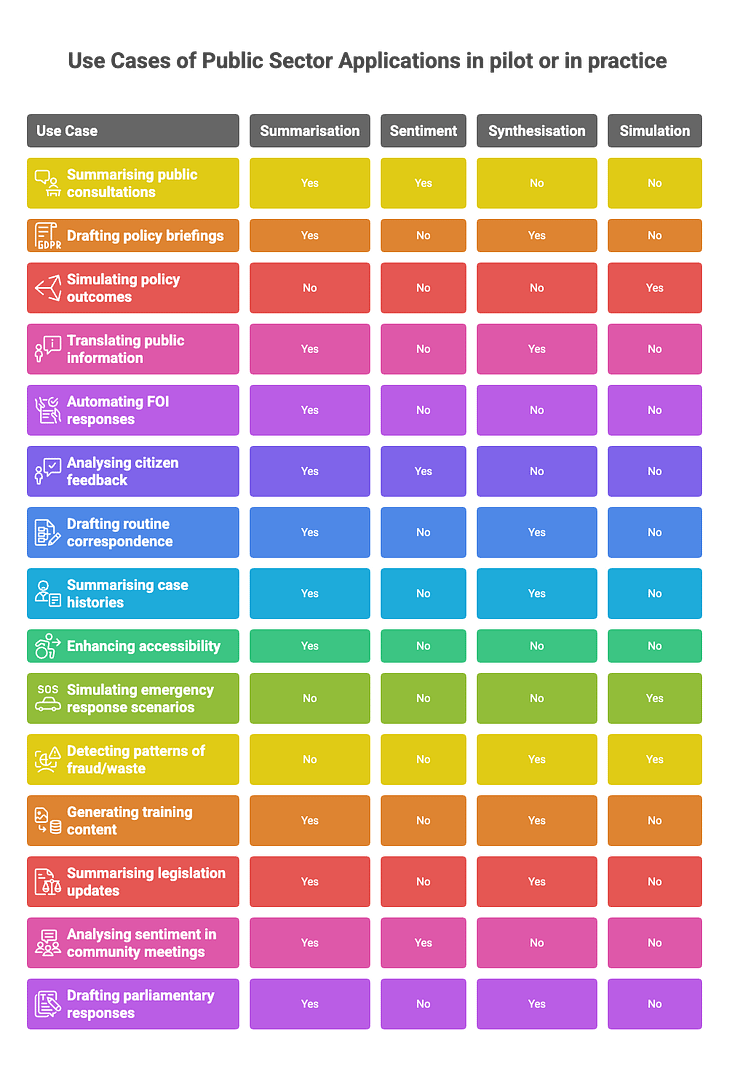
Overview of fifteen public-sector scenarios—ranging from summarising consultations to simulating emergency responses—and the generative AI capabilities (summarisation, sentiment, synthesisation, simulation) currently in pilot or in practice for each.
Most of these applications:
Start with text-based tasks rather than fully automated decisions.
Include human review as standard practice.
Can integrate into existing systems without major disruption.
Testing Readiness with the AI Compass
Before any pilot gets underway, it’s worth taking stock of your organisation’s readiness across four areas:
Culture
Do teams understand that AI is a tool to augment their work—not a threat to their roles?
Is there shared clarity on how GenAI fits into broader goals?
Governance
Are clear policies and accountability frameworks in place?
Do you know who owns the risks of AI outputs?
Talent
Do colleagues have the skills to validate, supervise, and improve AI work?
Are prompt engineering and AI literacy part of professional development?
Infrastructure
Is your data landscape secure and accessible enough to support GenAI?
Do you have sandbox environments for experimentation?
How Use Cases Map to Readiness Levels
Quick Wins (Low Readiness Barriers):
Drafting client correspondence
Summarising compliance policies
Translating documents
Generating training materials
Strategic Pilots (Moderate Readiness Gaps):
Simulating credit risk
Summarising market research
Analysing customer sentiment
Generating synthetic transaction data
Drafting investment summaries
Complex Initiatives (High Readiness Gaps):
Stress test simulations
Fraud network detection
ESG reporting automation
Multichannel marketing content
This sequence allows you to build credibility step by step while strengthening governance and skills.
A Roadmap for Responsible Adoption
Phase 1: Quick Wins (Months 1–6)
Focus on contained, low-risk areas.
Build momentum and demonstrate impact.
Phase 2: Strategic Pilots (Months 6–18)
Expand into higher-value use cases.
Formalise governance and skills development.
Phase 3: Complex Initiatives (Months 18–36)
Embed GenAI in sensitive, high-impact domains.
Ensure robust oversight and clear accountability.
Conclusion: A Human-First Future
Generative AI can fundamentally reshape financial services for the better—but only if adoption is guided by clear principles, strong governance, and a commitment to transparency.
By combining the 4S Productivity Stack with the AI Compass Readiness Framework, you can take a measured, human-centred approach:
Start small but build for scale.
Grow confidence alongside capability.
Make AI adoption as inclusive and trustworthy as it is efficient.
The time to act is now. In finance, leading with integrity isn’t optional—it’s essential.
generative ai in finance, ai adoption in banking, human centred ai strategy, UK fintech collaboration, financial services innovation