A Crossroads for Public Sector AI
Public bodies across the UK and beyond are standing at a crossroads. Generative AI (GenAI) has the potential to improve public services, support better decision-making, and strengthen how institutions engage with communities. Yet unlike the private sector, government has a unique responsibility to balance this promise with public trust, fairness, and accountability.
Many organisations feel constrained by legacy systems, compliance obligations, and the understandable caution that comes with serving diverse communities. But delaying adoption also carries risks – from stagnation to a growing gap between public expectations and service delivery.
The question is no longer whether to adopt AI, but how to do it in a way that is transparent, inclusive and safe.
This guide introduces two practical frameworks:
- The 4S Productivity Stack – a set of GenAI capabilities designed to keep people at the centre of innovation.
- The AI Compass Readiness Framework – a way to understand whether your organisation has the mindset, policies, skills, and systems needed to adopt AI responsibly.
Used together, they provide a clear path to move forward with confidence.
The 4S Productivity Stack: Four Capabilities for Human-First AI
The 4S Stack groups GenAI tools into four pillars:
- Simulation
- Model “what if” scenarios to test policies before implementation.
- Summarisation
- Condense complex material so that it is easier to understand and share.
- Synthesisation
- Connect insights across teams, departments, and datasets.
- Sentiment
- Understand public perspectives and emerging concerns to inform decision-making.
These capabilities are designed to strengthen human judgement rather than replace it, making them a sensible place to start.
Aligning 4S to Public Sector Challenges
Each capability responds to common barriers:
- Simulation helps counter risk aversion and policy inertia.
- Summarisation cuts through information overload.
- Synthesisation bridges organisational silos.
- Sentiment supports more responsive and empathetic services.
By starting with these foundations, organisations can build skills and confidence gradually.
Where GenAI is Already Adding Value
Here are some examples of where GenAI is being used or piloted in public services, along with how they align to the 4S framework:
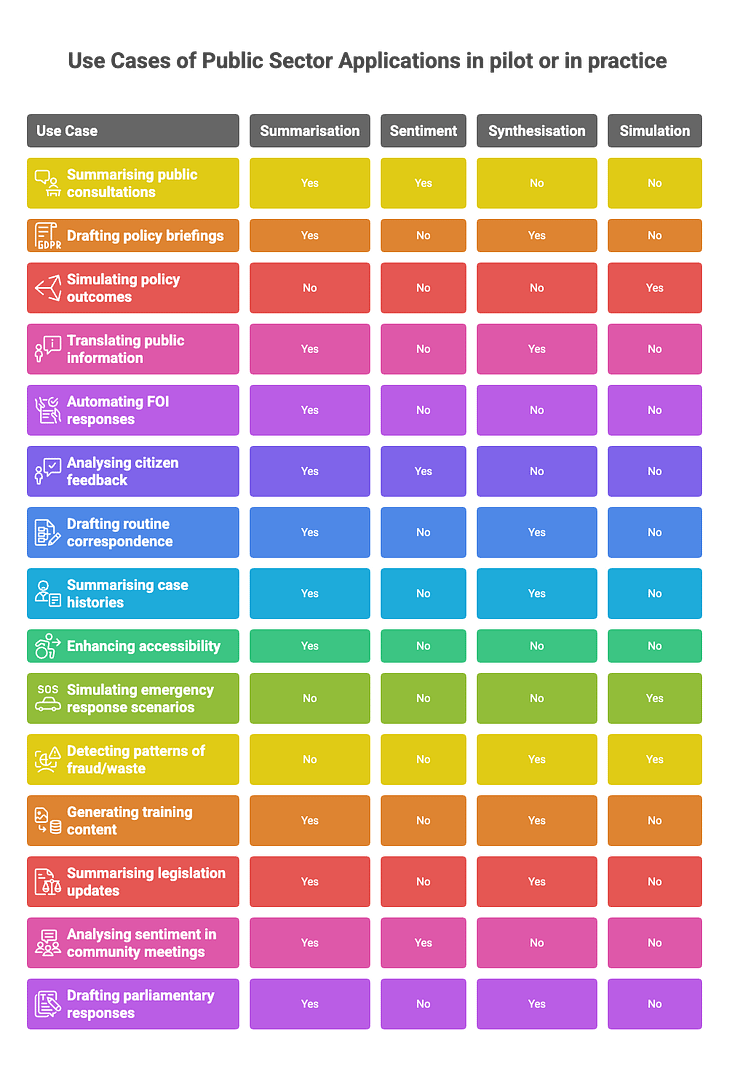
These examples show that GenAI adoption doesn’t need to be high-risk or disruptive. Most solutions focus on augmenting knowledge and supporting staff rather than automating decisions.
Assessing Readiness with the AI Compass
Before moving ahead with any project, it is important to assess organisational readiness across four areas:
- Culture
- Do teams see AI as an opportunity to improve their work?
- Governance
- Are clear policies and accountability measures in place?
- Talent
- Do people have the skills and confidence to engage with AI tools?
- Infrastructure
- Can systems and data support new capabilities?
Based on these dimensions, use cases can be grouped by readiness level:
Quick Wins (Low Readiness Barriers):
- Translating public information
- Drafting correspondence
- Enhancing accessibility
- Developing training content
Strategic Pilots (Moderate Readiness Gaps):
- Summarising consultations
- Simulating policies
- Automating FOI responses
- Analysing citizen feedback
- Summarising legislation
- Analysing sentiment
Complex Initiatives (Higher Readiness Gaps):
- Drafting policy briefs
- Simulating emergency scenarios
- Detecting fraud and waste
- Drafting parliamentary responses
Sequencing projects in this way helps teams learn, adapt and demonstrate value incrementally.
A Roadmap for Responsible Adoption
Phase 1: Quick Wins (Months 1–6)
- Pilot low-risk applications that are easy to explain and validate.
- Build trust and demonstrate early value.
Phase 2: Strategic Pilots (Months 6–18)
- Expand to more complex use cases with stronger governance support.
- Develop skills and embed ethical oversight.
Phase 3: Complex Initiatives (Months 18–36)
- Scale responsibly into higher-impact, sensitive areas.
- Fully integrate human-first AI into everyday operations.
This measured approach helps safeguard public trust and maintain transparency.
Conclusion: Leading with Integrity
AI offers public sector organisations a chance to improve services, save time and respond more effectively to people’s needs. But technology alone is not the solution.
The combination of the 4S Productivity Stack and the AI Compass Readiness Framework provides a practical way to balance innovation with accountability.
By starting small, building capacity and focusing on human-first principles, public bodies can ensure AI adoption is both effective and ethical.
The time to act is now – and to act responsibly.